
Most People Never Decide. They Just Continue.
The difference between a chosen life and an inherited one and the practice of building from the inside out
There is a specific kind of exhaustion that has nothing to do with how hard we have been working.
It arrives quietly, usually on an ordinary evening, when nothing dramatic has happened and there is no obvious reason to feel it. The day was fine. The week was manageable. Life, by any reasonable measure, is proceeding. And yet underneath all of it is a low, persistent hum with the feeling of someone moving through a life they cannot quite claim as entirely their own.
Most people have felt this. Very few have named it honestly.
It is not burnout. It is not depression. It is not ingratitude. It is the feeling of a life that has been lived more in response to things than in genuine direction. A life assembled from decisions that were each, at the time, completely reasonable and that have accumulated, slowly and without ceremony, into something that fits well enough but was never quite deliberately chosen.
There is a line that stayed with me, one I keep returning to.
It is a choice we keep making until it becomes, slowly and without ceremony, just who we are.
That is the end of one conversation and the beginning of a harder one.
Because stopping is not the same as starting. Clearing the space is not the same as knowing what to build in it. Learning what we are not willing to live for is real and necessary work, but it leaves us standing in an open field, which is either liberating or terrifying depending on how long it has been since we were last there.
The question underneath all of it and the one most people spend enormous energy avoiding is this:
What are you actually living for?
Not the acceptable answer. Not the version we would say in an interview or at a dinner party. The honest one.
Most people, if they sit with that question long enough, discover something uncomfortable.
They do not know.
There is a word the Stoics used that has no clean modern equivalent.
Telos.
It does not mean goal. It does not mean purpose in the self-help sense or the five year plan, the vision board, the mission statement. It means something more foundational than any of those. It means the direction a life is oriented toward. The thing a person is fundamentally trying to become through all the small daily choices they make.
The Stoics believed that most human suffering came not from difficult circumstances but from the absence of a genuine “telos” from living without real direction, driven by whatever was most urgent, most expected, or most loudly demanded. A life without telos is not necessarily a bad life. It can look very good from the outside. It can be productive, comfortable, full of achievement.
It just has no centre.
And a life with no centre cannot hold… not permanently, not under pressure, not when the comfortable conditions that were keeping it in shape start to change.
The question is not whether you are living a good life. It is whether you are living your own.
I spent a long time mistaking momentum for direction.
If enough things were moving and if the work was happening, if plans were forming, if I was productive and engaged and busy, it felt like I was going somewhere. The feeling of motion was convincing. It was only when things slowed down, when I was forced to be still for long enough to actually look, that I noticed something.
I could not say, with any real honesty, where I was going.
Not in the small sense of not knowing the next career move or the five year plan. In a deeper sense. I had accumulated a life that was coherent, that made sense to the people around me, that I had reasonable explanations for — but I had not, at any point I could identify, sat down and asked what I actually wanted it to be for.
What I had done, mostly, was continue.
I had responded to what was in front of me with reasonable intelligence and decent effort. I had made the next sensible move. I had inherited assumptions about what a good life looked like and worked toward them without examining whether they were mine. I had been, in the fullest sense of the word, reactive.
The Stoics had a word for this. They called it living according to phantasia which is according to appearances, according to what seemed important rather than what genuinely was. Letting the surface of life set the agenda while the deeper questions stayed quietly unanswered.
The honest version of this is not comfortable to sit with.
But it is the beginning of something real.
The inherited life is not dramatic.
It does not announce itself. It does not feel, from the inside, like a failure or a mistake. It feels like being a reasonable person navigating a complicated world. It feels like someone who has their priorities straight and is working toward something.
The tell is in the quality of the energy behind the working.
There is a difference between the tiredness of someone who has been building toward something genuinely theirs and the tiredness of someone who has been performing competence at a life they never quite consciously chose. They look identical from the outside. They feel completely different from the inside. One leaves you tired in a way that still has something underneath it — a sense of direction, of earning something, of being inside the right story. The other leaves you tired in a way that has nothing underneath it at all.
Most people have spent so long responding to the world that they have forgotten what it feels like to come from somewhere inside themselves instead.
What changes is not the external structure of the life. Not immediately, and sometimes not at all.
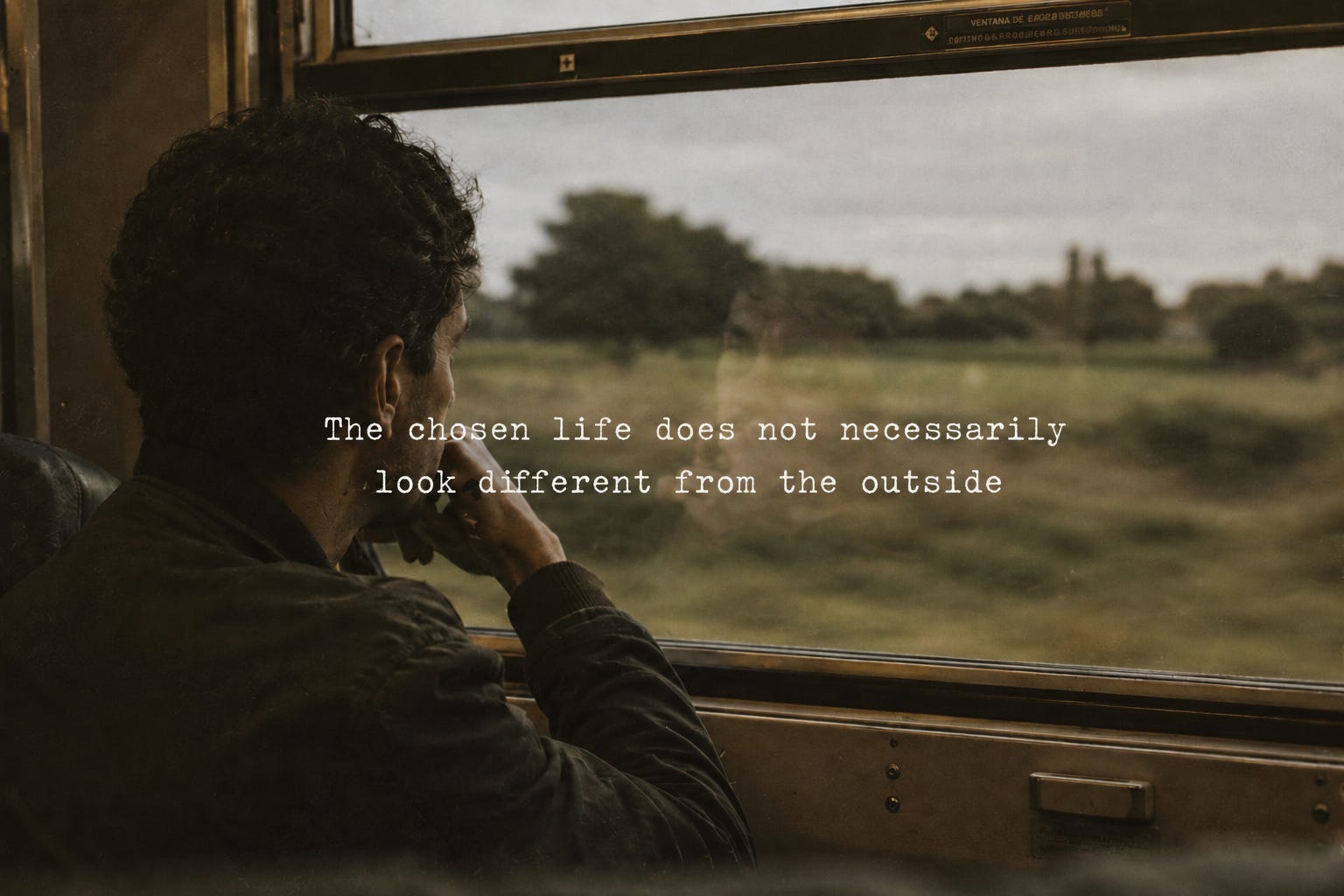
The chosen life does not necessarily look different from the outside. The job might be the same. The relationships might be the same. The daily routine might look almost identical to the one that came before.
What changes is the relationship to it. The sense of authorship. The feeling of being inside our own life rather than inside a very convincing approximation of one.
That shift is not dramatic. It is one of the quietest things that can happen to a person. But it is also one of the most significant because it changes the quality of everything. Not the content. The quality. The difference between doing the same thing from obligation and doing the same thing from genuine choice is not visible in the action. It is entirely visible in the person doing it.
This is what the Stoics were pointing at with telos. Not a destination. A relationship to our own life. An orientation that is genuinely ours rather than assembled from what other people needed us to be.
The work of building that relationship is not a one-time event. It is a practice. A daily, unglamorous, genuinely useful practice that has nothing to do with vision boards or life audits or finding your passion.
Most people never build it because the noise never stops long enough for them to hear themselves clearly.
What follows is how to make it stop.
