
The Life You Stop Performing
The performed self, the private one, and the quiet work of closing the distance between them
I was invited to dinner, a few years ago, with people I had known for a long time.
Good people. People who cared about me. And somewhere in the middle of it I said something about a story about how things were going, confident and composed and entirely on par with my goals and even as I was saying it I felt, somewhere underneath the words, a slight internal distance. A recognition that the version being presented was accurate in the way that a highlight reel is accurate. Nothing false. Nothing fabricated. Just edited to show what’s only necessary. The complicated parts smoothed over. The uncertainty managed. The version that would be received well, rather than the version that was actually true.
Nobody noticed. Nobody had any reason to.
That was what made it strange.
I drove home that evening with the particular flatness that follows a performance gone well. Not relief. Not satisfaction. Just the quiet aftermath of having been somewhere for several hours without quite being there.
It took a long time to understand what that feeling was.
It was the cost of the gap.
Nobody really decides to start performing.
That is the first thing worth saying honestly, because the word performance implies a choice that was never quite made.
It begins in increments so small they are invisible at the time. The opinion softened because the room was not ready for the full version. The feeling managed rather than expressed because the moment did not seem right. The version of the story told that leaves out the part that makes things complicated. Each of these is a small, entirely reasonable decision in the moment. None of them costs anything significant on their own.
The cost accumulates.
After enough increments the edited version becomes the default one. Not a mask worn deliberately but something more like a second skin. The version of ourself that knows how to be received, how to avoid friction, how to keep things comfortable for the people around us.
And somewhere underneath it, quieter every year, the unedited one.
Psychology researchers now have a name for this. They call it the authenticity gap which the measurable distance between the self that is presented and the self that is actually experienced. The wider the gap, the greater the psychological strain. Not dramatically. Just consistently. A low-grade tension that never fully resolves because it cannot be resolved from the outside. It lives entirely on the inside, in the distance between what is shown and what is true.
Nobody decides to start performing. It just becomes what works. And what works, repeated long enough, becomes who you think you are.
The cost of the gap is not what most people expect.
It is not exposure. Not the fear of being found out nor the dramatic consequence of a performed self finally collapsing under the weight of itself.
It is quieter than that.
It is the exhaustion that has no obvious source at the end of days that went perfectly well. The sense, in certain moments, that even the people who love us are loving a version of us rather than the actual thing. The particular loneliness of being in a room full of people who would help us if they knew and not knowing because we have been performing capable for so long that the asking has become almost structurally impossible.
I know this from a specific season of my own life.
Not a crisis season. A fine one, by most measures. The work was going well. The relationships were intact. Nothing was wrong in any way I could point to. And yet there was something which felt like a persistent low-grade flatness underneath everything, a sense of slight unreality in my own days that I could not account for by looking at the circumstances.
The circumstances were fine.
The gap was wide.
What was costing me was not what was happening. It was the energy spent daily, invisibly, maintaining a distance between what was true and what was shown. Between who I was in the private hours of my own thinking and who I was in every room that required something of me.
The Stoics observed something about this that has since been confirmed by modern research. The person who presents an edited version consistently across contexts, across relationships, over years finally begins to lose the ability to distinguish between the performance and the reality. The performed confidence becomes indistinguishable from genuine confidence. The performed composure becomes indistinguishable from actual composure. Until one day, in a quiet moment, a question arrives that takes longer to answer than it should.
What do I actually think?
Not what do I say I think. Not what do I know I should think. What do I actually think.
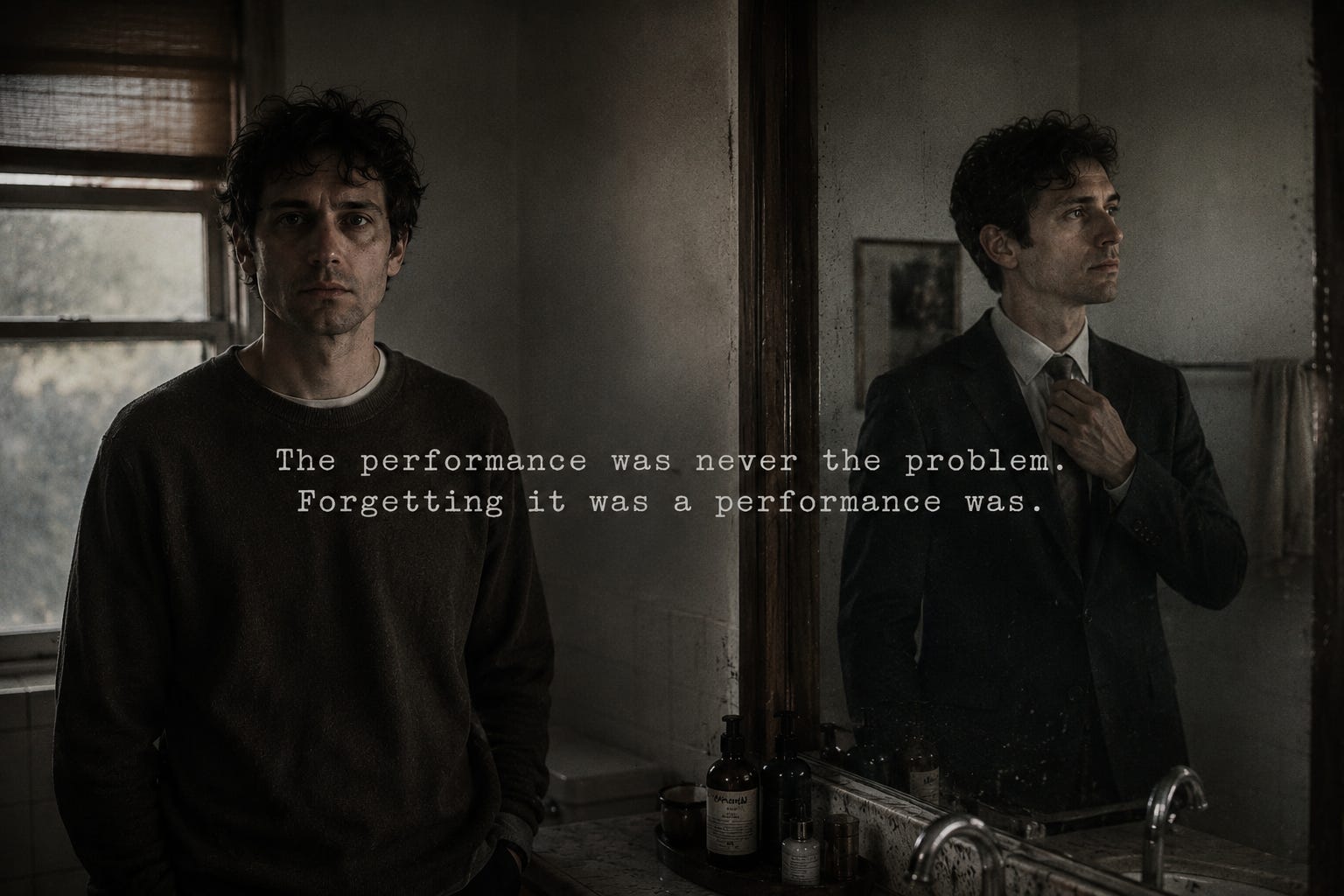
The performance was never the problem. Forgetting that it was a performance was
There is a version of ourself that exists only in the absence of an audience.
Not a hidden version. Not a shameful one. Simply the unedited one.
The person who thinks certain things that never become words. Who wants things that never become stated preferences. Who feels things that never become acknowledged feelings because the context for acknowledging them never quite arrives. Most people are most genuinely themselves in very specific, limited circumstances. Alone in the car. The first ten minutes of the morning before anything starts. The particular honesty that comes at the end of a genuinely good conversation with someone who needs nothing from them.
These moments are not escapes from real life.
They are the closest thing to it.
What the Stoics called “prosoche” self-attention, the daily practice of turning inward honestly was built around exactly this recognition. That the person we are when nothing is required of us is more real and more useful than the person assembled for different contexts. That genuine self-knowledge is only available through honest contact with the unedited self. Not the performed one. Not the edited one. The one that exists in the private hours before the presentation begins.
The private self is not the best version of us.
It is just the actual one.
And the gap between that version and the one most people see is where most of the unnecessary exhaustion lives.
It does not look like the conversation where we finally said everything. The moment of radical honesty. The clean break with the version that was never quite true.
It looks considerably smaller than that.
The opinion stated as an opinion rather than softened into a question. The feeling named rather than managed around. The version of the story that includes the part we usually leave out. The moment we let someone see us uncertain rather than composing ourself before answering.
None of these feel significant in isolation.
Together, over time, they are the most significant work available.
The alignment between internal experience and external presentation is directly associated with wellbeing, relationship satisfaction, and a quality of engagement with our own life that the performed version cannot produce. Not because performance is wrong or dishonest. Because it is exhausting in a way that compounds invisibly until the exhaustion simply becomes the background condition of the life.
The alternative is not exposure. It is not performing the authentic self which is its own kind of performance and equally hollow.
It is the gradual, unglamorous practice of letting the gap close and allowing the people closest to us to know, slowly and without ceremony, slightly more of the actual thing.
That process does not require courage in the cinematic sense.
It requires consistency. The small, repeated choice to say the true thing rather than the safe thing, in the moments when the difference between them matters.
Genuine connection is only available between real people. The performed self, however polished, cannot receive it.
There is a difference between seeing the gap clearly and doing something about it.
Most of the work of an examined life lives in that difference. Not in the moments of recognition but in the deliberate, unglamorous thing that happens after the recognition. The part that has no audience and no immediate reward and produces nothing visible for a long time.
That part is worth spending real time with.
