
The Life You Want Doesn't Require Approval
Breaking free from the version of yourself the world finds comfortable and reclaiming the life you have been politely holding back
There is a conversation most people never finish.
It starts somewhere in childhood, when we first wanted something that made the adults around you nervous. A dream that didn’t fit the shape of what was expected of us. A direction that looked nothing like the path everyone else was walking. And the adults, with maybe the best intentions in the world, said wait. Said be careful. Said are you sure?
And somewhere in the repetition of those words, we started asking ourselves their question instead of our own.
Not because we were weak. Because we are human. Because we are wired, from the very beginning, to seek the approval of the people we love before we move.
The problem is that you broke stopped that habit.
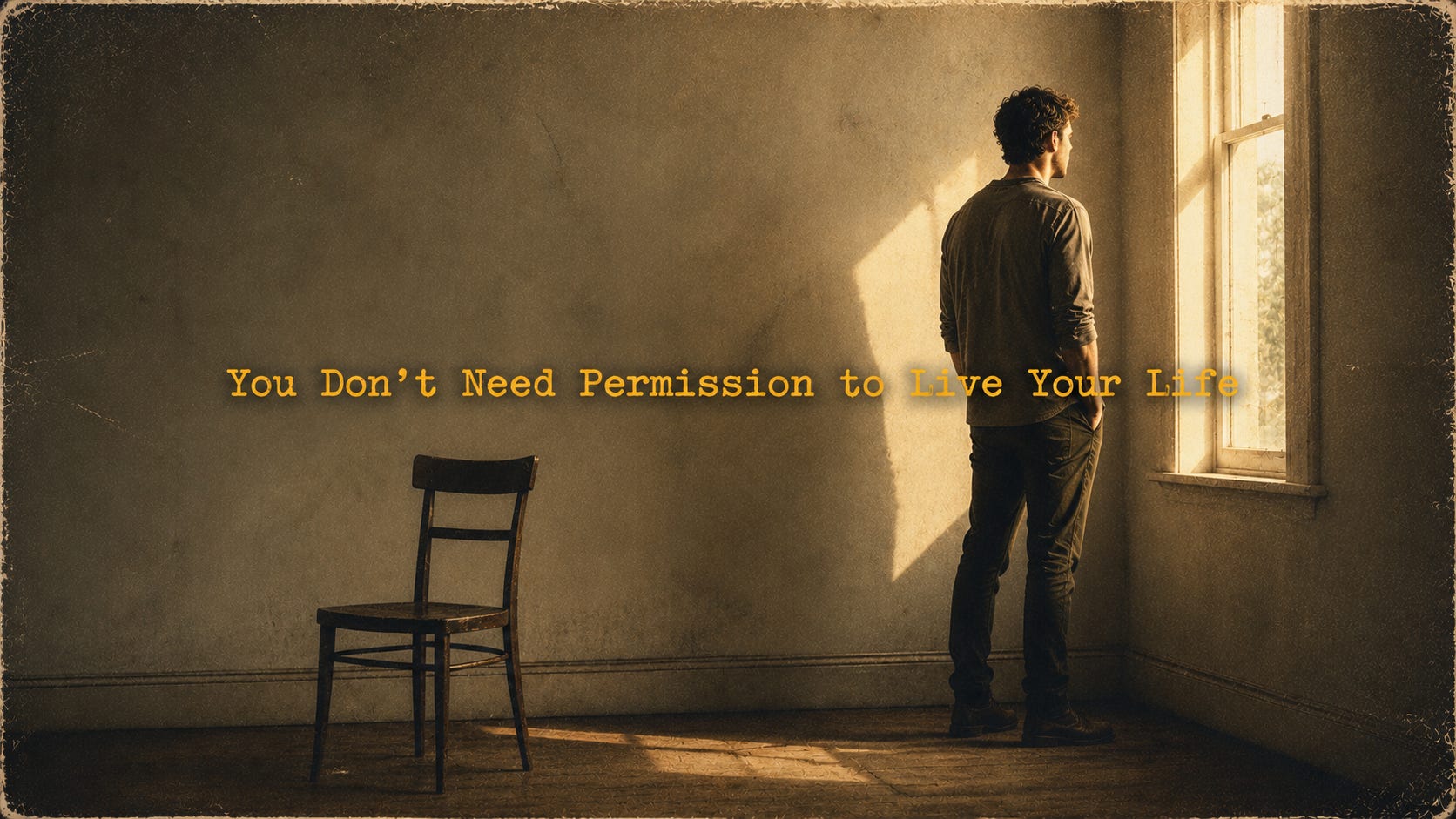
I want to tell you about a man named Cato.
Not a motivational figure. Not a self-help archetype. A real person who lived in one of the most politically brutal periods in Roman history, who watched everything he believed in, the republic, the principles he had built his life around were slowly dismantled by men with more power and less of a conscience.
He had every reason to comply. Every practical argument pointed toward surrender. The people around him adjusted, negotiated, made their peace with the new reality. It would have been so much easier to wait for a better moment. To ask permission from the circumstances before acting like himself.
But he never did.
“He has honour if he needs it not.” - Written of Cato by those who watched him live
Not because he was reckless. Because he understood something that most people spend their whole lives avoiding.
The life you keep waiting to start is already happening. Every day you spend waiting for conditions to improve, for someone to validate your direction, for the timing to feel right and that is not waiting. That is the life.
That is the chapter being written whether you show up for it or not.
There is a word for the cage most people live in.
We call it comfort.
It looks very reasonable from the outside. Stable job. Predictable routine. Relationships that don’t ask too much of us. A life that fits inside the lines other people drew for us.
But there is a particular kind of exhaustion that comes from a life lived inside those lines. Not physical exhaustion. Something deeper. The tiredness of a person who has been performing a version of themselves for so long they have forgotten what the original looked like. What they wanted to be for themselves
The Stoics had a name for this. They called it living contrary to nature but not nature in the environmental sense, but in the sense of your own deepest character. The self that exists underneath the performance we put on for the outside world. The person you are when nobody is watching and nothing is required of you.
Most people meet that person rarely in their lifetime.
In the silence before sleep. In the honest hour after a hard conversation. In the moment between deciding and doing, when everything gets very quiet.
That person has never been waiting for permission.
Musonius Rufus was a Stoic teacher who was exiled twice.
Not for violence. Not for crime but for speaking. For refusing to adjust what he believed to fit what the emperor wanted to hear. He was removed from Rome, sent to barren islands, stripped of his platform and both times he continued teaching, continued writing, continued living according to what he understood to be true.
What strikes me about him is not the drama of the exile.
It is the quiet before it.
The moment when he must have known what was coming if he kept speaking. When the practical voice in his head would have made a very reasonable case for softening, adjusting, finding a more acceptable way to say the same thing.
He kept speaking anyway.
“We suffer more in imagination than in reality.” - Musonius Rufus
Not out of stubbornness. Out of something that looked, from the outside, a lot like freedom.
Because the moment that we outsource the direction of your life to what is safe, what is acceptable, what the people around you can tolerate, Then we have given something away that is very hard to recover. Not our career. Not our reputation.
But something quieter than that.
Here is what nobody tells us about permission.
It feels like safety. It feels like wisdom. Waiting for the right moment, the right support, the right level of readiness and all of this has the texture of responsibility.
But underneath the waiting is almost always fear wearing a very respectable coat.
Fear of being wrong. Fear of being alone in our direction. Fear that if we move before someone gives us the green light, and it doesn’t work, there will be no one to blame but you.
And that last one is the real thing.
Because taking responsibility for our own life is not just about success. It is about owning the failures too. The wrong turns. The years spent on something that didn’t work out. The version of ourselves that we tried to build that turned out not to be what we needed.
Most people would rather have a permission slip for those failures than own them without one.
The Stoics called this something close to cowardice but not the dramatic kind, but the everyday kind. The slow abdication of our own judgment in favour of the crowd’s. The gradual surrender of our interior life to exterior approval.
Zeno of Citium, who founded the entire school of Stoic thought, started out as a merchant.
He survived a shipwreck that took everything he had. By almost any external measure, the practical thing was to rebuild what he had lost, return to what he knew, play it safe the second time around.
He walked into a bookshop in Athens, read Socrates, and changed the entire direction of his life.
No permission. No guarantee. No waiting until the conditions felt right.
Just the recognition that the shipwreck had taken everything except the only thing that had ever actually been his.
That thing was his judgment. His interior life. The capacity to decide, without anyone’s approval, what his life was going to be about.
I think about what it means to live in the modern version of this problem.
We are surrounded, constantly, by voices that have strong opinions about what our lives should look like. Not just the people close to us but strangers, platforms, the ambient pressure of a culture that has monetised the performance of a certain kind of success.
Everyone is watching.

And because everyone is watching, the pull toward the acceptable version of yourself has never been stronger.
But the acceptable version of yourself is not the interesting one. It is not the one that writes the thing that needed to be written, or builds the thing that needed to be built, or has the conversation that has needed to happen for three years.
The acceptable version of yourself is the one that stays quiet in the meeting. That keeps the dream at the level of a hobby. That posts the version of the truth that won’t make anyone uncomfortable.
Modern Stoic living is not about being hard. It is not about suppressing emotion or pretending difficulty doesn’t exist. It is about the quiet, daily practice of returning to your own judgment.
Of asking not what will be approved of, but what is actually true.
Of building, slowly and without fanfare, a life that belongs to you rather than to the audience watching it.
The permission we are waiting for is not coming.
Not because the people in your life don’t love us. Many of them do. But because nobody can give us permission to be yourself. The architecture of that particular freedom is entirely interior. It has to be built from the inside, one honest decision at a time, in the quiet moments when the noise dies down and we can hear your own thinking again.
Cato didn’t wait for Rome to agree with him.
Musonius didn’t wait for the emperor to approve his voice.
Zeno didn’t wait until the conditions were right to start over.
They simply decided that the life in front of them was theirs to live fully, honestly, without holding it at arm’s length until someone else gave them the signal.
That decision is available to you right now.
Not after the promotion. Not when the relationship is more stable. Not when we feel ready but because ready is a feeling that arrives after you begin, not before.
The chapter is already open.
The only question is whether you are going to write it or keep waiting for someone else to hand you the pen.
Talk soon,
Pathsofstoicism
This couldn't have come at a better time for me. So relevant to everything I'm working on and going through right now 🙌🏼
Superb analysis of life path.