
What You Control When Nothing Else Is Working
What a year of closed doors taught me about the difference between what you can control and what you can't.
In the year after I finished university, I applied for sixty-three jobs. I know the number exactly because I kept a spreadsheet, which felt productive at the time and, in hindsight, was mostly just a very detailed record of rejection.
Forty-one of them never replied at all. Fourteen sent the standard “we’ve decided to move forward with other candidates” email. Six got me to an interview. Two got me to a second round but none of them turned into an offer. Somewhere around application forty, I stopped updating my LinkedIn banner that said “open to work,” not because I’d found something, but because I couldn’t stand looking at it anymore.
What made that year hard wasn’t any single rejection. It was the specific, grinding feeling of doing everything you were told would work, tailoring each application, following up politely, practicing interview answers in the mirror, and watching none of it move the needle. I wasn’t lazy. I wasn’t careless. I was doing the work, consistently, and the results simply weren’t coming.
I remember a specific Thursday, maybe six months in, when I got two rejections in the same afternoon, one from a job I hadn’t even been that excited about, and one from a job I’d genuinely wanted. I sat on the floor of my room, not crying exactly, just staring at the wall for longer than I’d like to admit, thinking some version of what is the actual point of trying if trying doesn’t change anything.
Nobody warns you that the hardest slumps aren’t the ones where you’ve stopped trying. They’re the ones where you haven’t, and it isn’t working anyway.
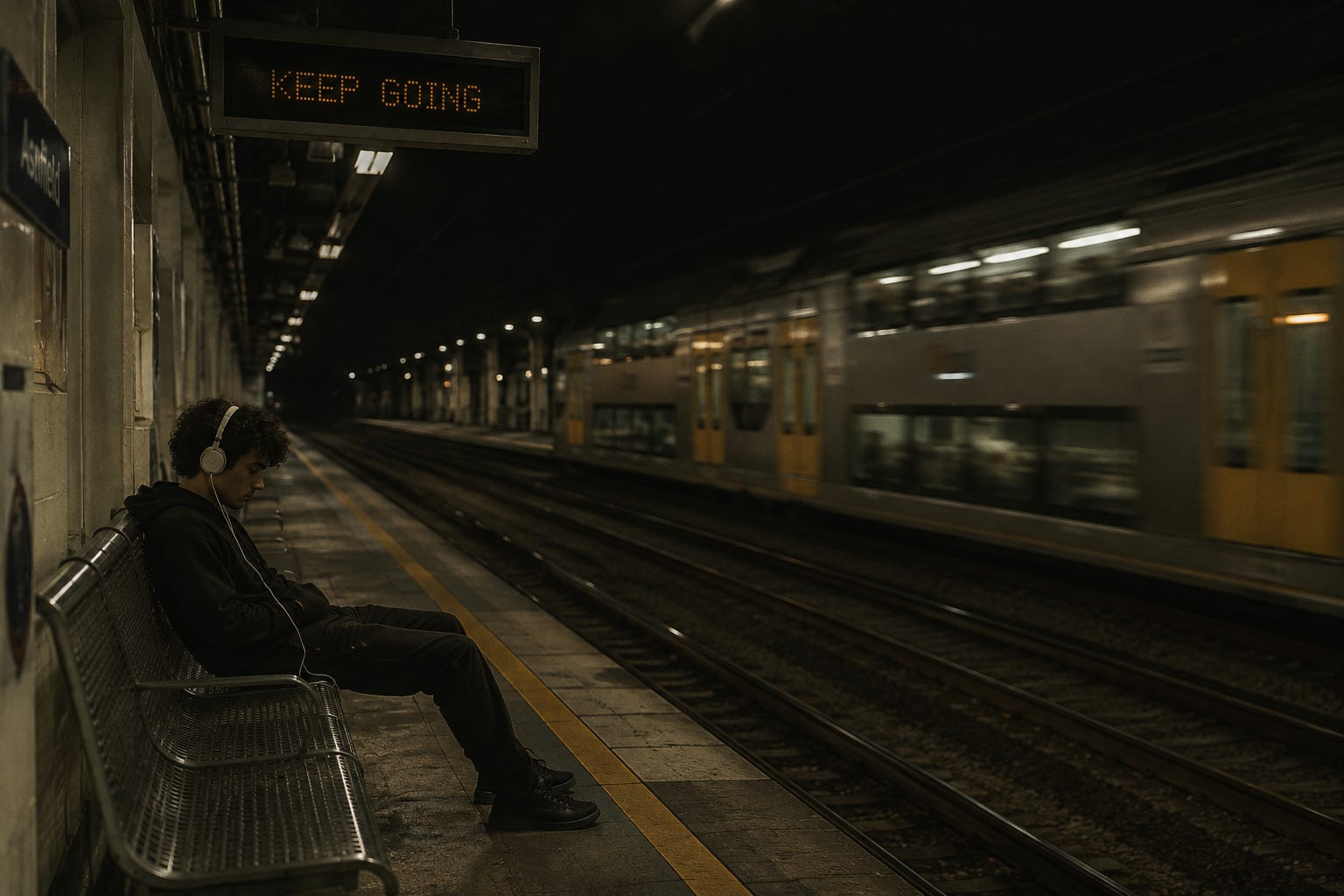
A slump where you’ve checked out is at least honest about its cause. I would know why nothing’s moving, I’ve stopped moving too. But a slump where I am doing everything right and still getting nowhere doesn’t offer me that clarity. It just quietly starts to erode my belief that effort and outcome are connected at all, and once that belief cracks, it’s hard to keep showing up the same way.
I started noticing the erosion in small ways before I could name it. I got slower at sending applications, not from laziness, but because some part of me had started expecting the rejection before I’d even hit send, which made the whole act feel pointless before I’d finished it. I stopped telling people I was job hunting, because I was tired of the look on their face when I said “still looking,” a look that, fairly or not, I read as quiet disappointment.
There’s an old distinction that ended up mattering more to me that year than almost anything else I’d read before it: some things are within your control, and some things simply aren’t, and most suffering comes from confusing the two. I could control the applications, the preparation, the follow-ups. I could not control whether a hiring manager opened my email, whether a role got frozen mid-process, whether someone internal got the job before it was ever really open. I’d been quietly holding myself responsible for outcomes that were never fully mine to control in the first place, and it was crushing me slowly, without my noticing exactly why.
None of this resolved with one insight. It resolved slowly, through a few specific shifts I made once I could finally see what was actually happening.
I separated effort from outcome, on paper, not just in theory. I kept my spreadsheet, but I added a column that had nothing to do with results: did I do the things within my control today, tailor the application, prepare properly, follow up on time. Some days the outcome column stayed empty for weeks. The effort column didn’t. Looking at that second column on the bad days was the only thing that reminded me I hadn’t actually stopped moving, even when it felt that way.
I stopped measuring the whole year by any single week. Early on, a bad week felt like proof the whole plan was failing. Later, I started zooming out on purpose, looking at effort and small signs of progress across a full month instead of a single Thursday. A month almost always told a more honest story than a week did.
I let myself grieve the specific rejections instead of pretending they didn’t hurt. For a while I tried to be stoic about it in the worst sense, pretending each no didn’t matter, and it just meant I was carrying all of it quietly instead of processing any of it. Once I let myself actually feel disappointed for an hour after a bad one, properly, instead of brushing past it, I noticed I recovered faster, not slower.
I looked for control in smaller places when the big picture offered none. I couldn’t control whether I got hired. I could control how I spent the hour after a rejection. Some days that meant a walk. Some days it meant calling a friend instead of opening my laptop again immediately. Small, but it was mine, and in a year that felt largely out of my hands, that mattered more than it sounds like it should.
The sixty-fourth application became an offer, for reasons I still can’t fully explain, the role wasn’t dramatically different from the others, the process wasn’t shorter, nothing about it signaled in advance that this would be the one. It just was.
I don’t think the lesson here is that persistence guarantees an outcome eventually, that’s a comforting story but not always a true one. What I do believe, because I lived through it, is that persistence is the only thing you actually have control over while you’re waiting to find out. The outcome was never guaranteed. What I did with the year while I waited for it was.
If you’re in a stretch like that right now, where the effort isn’t translating into anything yet, I don’t have a way to promise you it will. I can tell you that the effort column still counts, even on the weeks the outcome column stays empty.
Focussing on what you can control sometimes feels like a superpower - it's too easy to feel like you're doing everything you can, and are still not getting anywhere - or even, in today's social media world, feeling like everyone else is somehow moving forwards and you're stuck in limbo. Persistence and showing up doesn't get as much credit as both should - thank you for the article, it reminds me I should probably write another substack post myself (my consistency is terrible!).
I so resonate with this. As a freelance writer years ago, pre-Internet, I sent out proposals via snail mail with self-addressed, stamped envelopes enclosed. As a fellow freelancer put it, I could have wallpapered my downstairs bathroom with all those rejection letters that showed up in my mailbox. It is just by sheer grit sometimes that we prevail—good for you for not giving up until that 64th letter! I suspect you are not giving up on Substack either! Carry it on!!